The Backyard Orchard Fit Kit
Choose fruit trees that fit your winter, your space and your table: chill counted month by month and in the model each variety is sold by, the hardiness zone checked separately, tree spots counted on the plot's sides, and the trees your household can actually use
OrchardHome's free calculators estimate a winter's chill hours from one typical day, give trees per 1,000 sq ft by dividing an area by a tree's spacing, and ramp a tree's yield to its grown figure. Each answers one question well; none of them tells you which varieties will bloom where you live, how many trees your actual plot holds, or how many trees your household can use. The Backyard Orchard Fit Kit carries those calculators through the decision. It counts your winter month by month (in the kit's example cold garden, one average day overstates the winter by 23%, 1,405 chill hours against 1,144), compares each variety in the chill model its tag uses and at the top of its range, and checks the 2023 USDA hardiness zone as a separate number. Then it counts tree spots on the plot's own sides with a setback from the fence (a 60 by 10 ft strip holds six dwarf apples where the area says four, and no semi-dwarf at all where the area says two), sizes the planting to your household's target (a side yard that holds eight dwarf apples, about 720 lb a year, against a household that wants 150 lb and needs a pollination pair), and writes out the years before full crop and one calendar for pruning and harvest. Every figure is computed by the code our calculators run, and every worked garden, plot and target is an example for you to replace. The setback and the yield band are rules of thumb and called so; it names no nursery or product and gives no spray figures. Included: a 24-page printable PDF with seven steps, a winter count sheet, a plot and tree-spot sheet, a tree plan and ramp sheet, an orchard year log, reference tables and a quickstart, plus a personalised sheet worked from the numbers you entered in our calculators.
Look inside
Two full pages from the kit, exactly as printed. Click either to read it at full size before you decide.
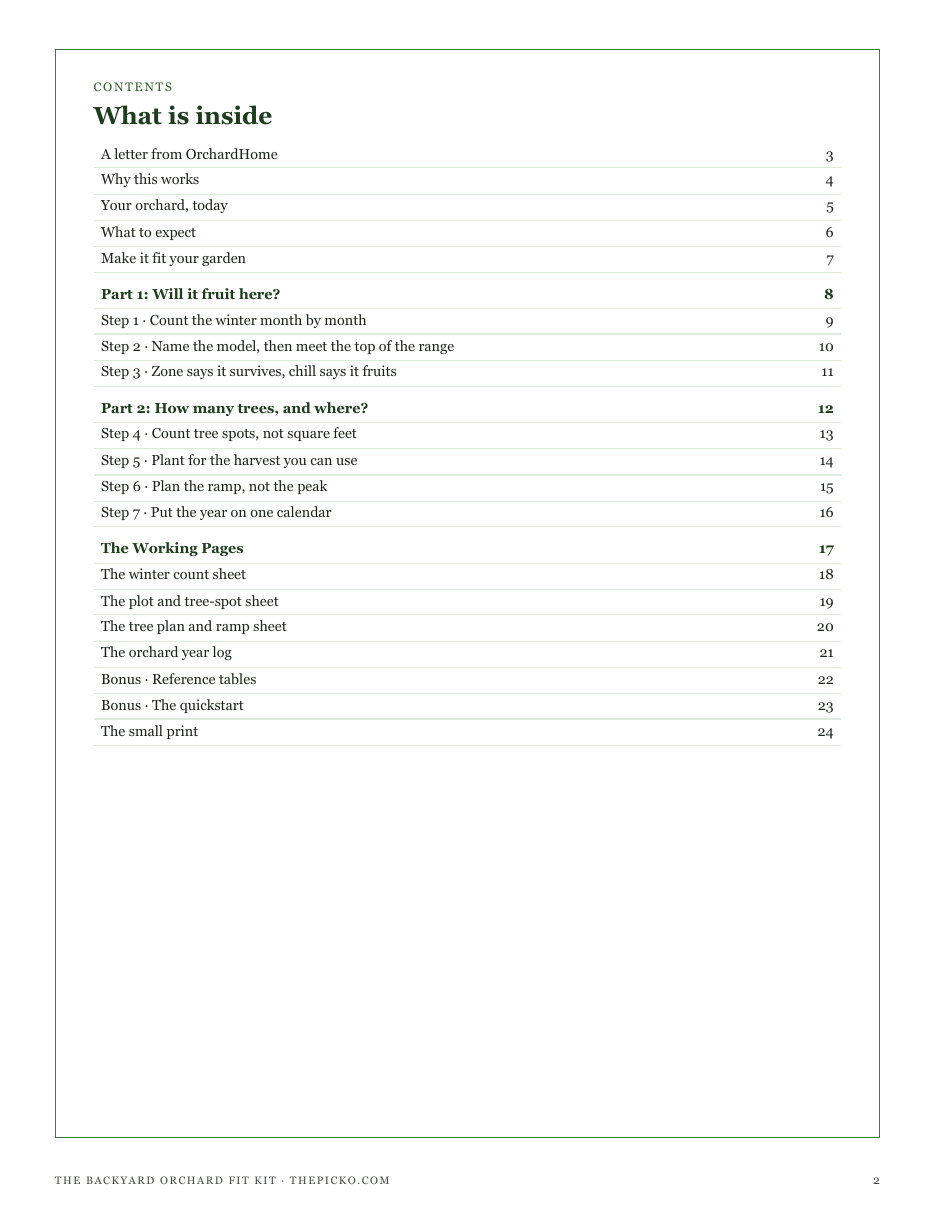
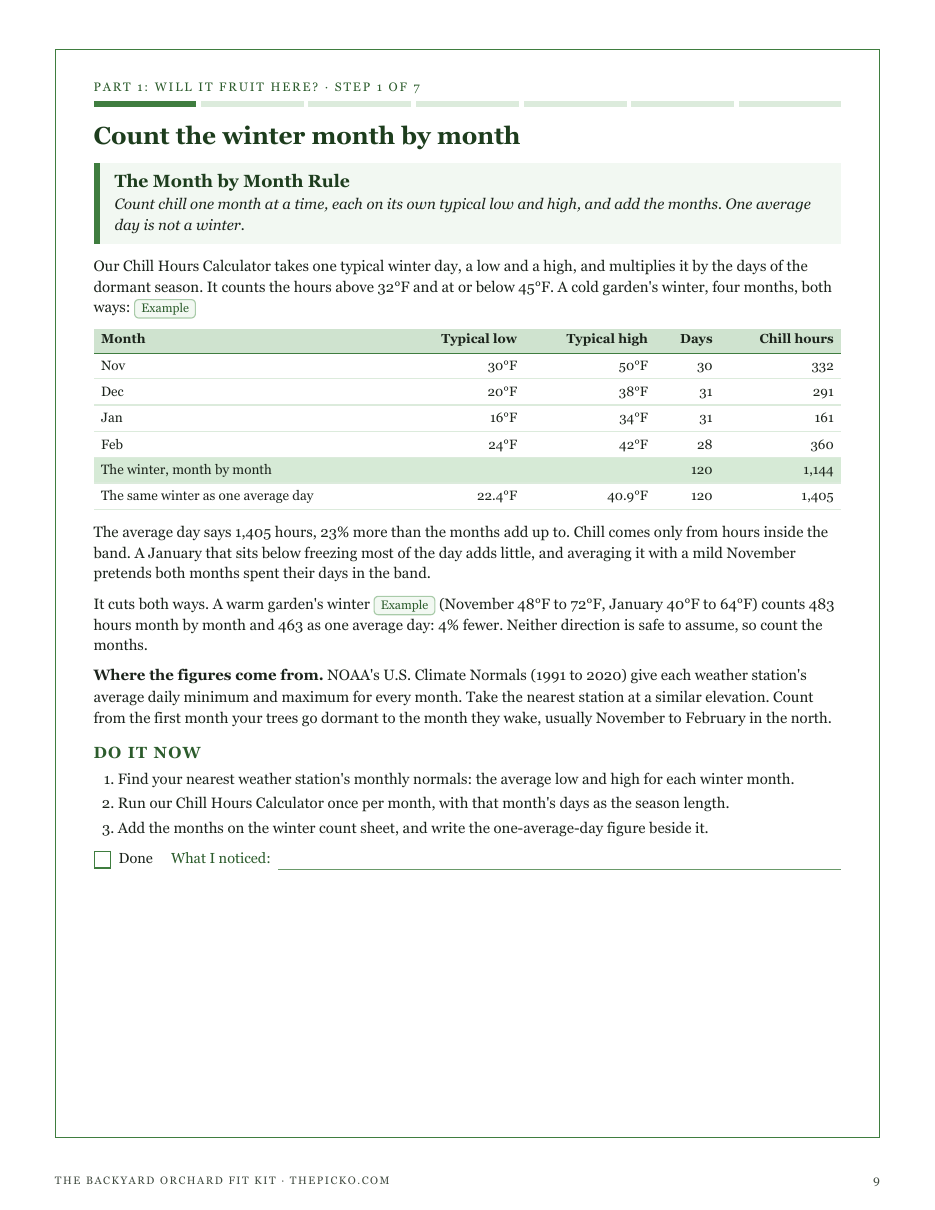
What is in it
- The Month by Month Rule: your winter's chill counted one month at a time, not from one average day
- The Top of the Range Rule: each variety compared in its own chill model (hours, Utah units or portions), at the top of its range
- The Two Numbers Rule: the 2023 USDA hardiness zone checked separately from the chill
- The Tree Spot Rule: trees counted on the plot's own sides with a setback, both row directions
- The Table, Not the Yard Rule: trees sized to your household's target, with good-year and poor-year counts and pollination partners
- The Ramp Rule: pounds year by year from planting to full crop
- The One Calendar Rule: pruning, bloom, thinning and harvest windows for your zone
- Four printable working pages: winter count sheet, plot and tree-spot sheet, tree plan and ramp sheet, orchard year log
- Reference tables: tree spots by plot size and rootstock, one-day chill hours and Utah units, hardiness zone bands
- A quickstart checklist and a personalised sheet worked from your own calculator inputs
- ✓ 24 printable pages
- ✓ 10 sections, worksheets and templates
- ✓ A second PDF worked out from the numbers you enter
- ✓ No account needed, just an email address
- ✓ Instant download; link valid 7 days
Price includes any taxes. Sold by GrabURL, who handle checkout and support. The charge appears on your statement as GrabURL.
The kit picks up where the free Fruit Yield Estimator leaves off. That estimator ramps a tree from its first light crop to its grown figure; the Chill Hours Calculator counts a winter from one typical day; and the Tree Planning Referencedivides an area by the spacing from the Tree Spacing Calculator. The kit carries them through: the winter counted month by month and compared in the chill model each variety is sold by, at the top of its range; the hardiness zone checked separately; tree spots counted on the plot’s own sides; the number of trees sized to the fruit your household can use, with pollination partners; the years before full crop; and one calendar for pruning and harvest. Every figure in it is an example for you to replace. It covers trees you plant; use any spray only as its label directs.